DCHOUSE 12V 100Ah Group 31 Bluetooth LiFePO4 Review UK 2026
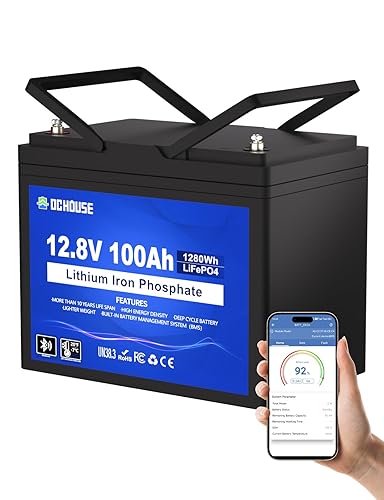
Quick verdict
Score: 9.5/10
Best for: Maximum usable power, long life and low weight, if the budget allows
Not for: The tightest budgets, or charging from a lead-acid-only charger
Bottom line: A practical leisure battery (lithium (LiFePO4), 100Ah) for off-grid and leisure power.
Overall, the DCHOUSE 12V 100Ah Group battery is a practical deep-cycle option for leisure use, with a rated capacity of 100Ah at 12V and a 5000+ cycle life for off-grid and solar use. It fits RV, solar and trolling motor setups where lithium leisure battery performance is required.
Key specifications
| Spec | Value |
|---|---|
| Capacity/Voltage | 100Ah, 12V |
| Form Factor | Group 31 |
| BMS/Protection | 100A BMS, low-temp protection |
Pros
- Lithium (LiFePO4) - most usable capacity and longest life
- 100Ah at 12V
- 5000 cycles rated life
- Suits solar / off-grid
- Built-in BMS, Bluetooth monitoring
Cons
- Higher upfront cost, and needs a lithium-profile charger
- Avoid charging below freezing without low-temp protection
- Match the capacity to your real daily power draw
Battery Type and Chemistry
LiFePO4 (lithium iron phosphate) is the chemistry used in the DCHOUSE battery. LiFePO4 is commonly selected for leisure and off-grid systems because it is designed for deep cycling. This battery is also described as having a built-in 100A BMS with low-temp protection, supporting safer operation when temperatures are less ideal. Compared with some other lithium chemistries, LiFePO4 typically involves higher cycle durability, although specific advantages depend on charging setup and use patterns.
Capacity and Real Usable Power
A 12V 100Ah rating is the starting point for understanding the energy the DCHOUSE 12V 100Ah Group battery can deliver in real use, but "100Ah" is a capacity figure measured at a defined discharge test and does not guarantee identical usable power under every load and temperature. The leisure battery pack is rated at 12V and 100Ah, giving a nominal energy of about 1.2 kWh (12V x 100Ah). In real-world use, usable energy can be lower if the battery voltage sags under higher current, or if output is limited at low temperatures. Buyers should base expectations on the intended load current, then allow for usable energy to be below the nominal figure.
Cycle Life and Durability
With a stated 5000+ cycle life, the DCHOUSE battery is designed for repeated deep-cycle use, which suits applications such as RVs, off-grid solar setups, and battery-stressed uses including trolling motors. LiFePO4 batteries are typically rated for many discharge-refill cycles.
Fitting and Charging
Fitting and charging the DCHOUSE 12V 100Ah Group battery typically begins with confirming physical fit, including Group 31 dimensions and terminal layout, for the intended RV or off-grid solar installation. Once the battery is positioned correctly, the installer connects the positive and negative terminals securely and secures the pack to minimise vibration. For charging, compatibility with a suitable 12V LiFePO4 charging approach is required, and the charger settings should be matched to the battery before charging starts. The battery should be monitored during the initial charge phase until voltage behaviour is stable, and charging should not be left unattended until safe operation is confirmed.
Who Is This For?
This battery is aimed at people planning an RV or off-grid solar setup who want a 12V LiFePO4 deep-cycle lithium option suited to frequent cycling, and it may also suit trolling motor use. It is designed to fit a Group 31 size battery space and provide 100Ah capacity for day-to-day energy use where demands vary across the day. The battery includes a 100A BMS with low-temp protection to help prevent unsafe operation if conditions change. Bluetooth monitoring lets users check status without opening the system. Buyers who need specific charging settings should confirm compatibility first.
Where to Buy in the UK
Several UK buyers look for the DCHOUSE 12V 100Ah Group battery through online retailers that stock lithium leisure batteries, since this format is commonly used for RV and off-grid solar setups. They compare product listings across specialist sites, focusing on the listed LiFePO4 chemistry, the 12V output, and the stated 100Ah capacity. Some listings highlight a built-in BMS with low-temperature protection, which affects real-world charging safety. Others check whether the Group 31 sizing fits their existing battery tray, because physical compatibility can limit installation options. Where stock varies, delivery timing becomes the main trade-off.
Frequently Asked Questions
Is the DCHOUSE worth it?
For powering solar / off-grid, the leisure battery (a lithium (LiFePO4) battery) rated at 100Ah does the job. The right choice depends on how much power you draw, how you charge, and your budget - lithium costs more upfront but lasts far longer and gives more usable capacity. Check the current Amazon UK price against the cost-per-cycle, not just the sticker.
What type of battery is the DCHOUSE?
The leisure battery is a lithium (LiFePO4) battery. Lithium gives you far more usable capacity (you can safely use most of the rated Ah, versus roughly half on lead-acid), a much longer cycle life, faster charging and a fraction of the weight. It costs significantly more upfront, and needs a charger with a lithium profile, but the cost per usable cycle is usually lower over its life.
How much power does this leisure battery give?
The DCHOUSE is rated at 100Ah at 12V. Crucially, USABLE capacity is not the same as rated capacity: with lithium you can safely use most of it, but with lead-acid, AGM and gel you should only draw around half before recharging, or you'll shorten its life. So a 100Ah lead-acid battery gives roughly half that in day-to-day usable power. Size your battery to your actual daily draw with that in mind.
How long will the DCHOUSE 12V 100Ah Group last?
The leisure battery is rated for around 5000 cycles. Cycle life is how many charge-discharge cycles the battery gives before its capacity drops meaningfully, and it's where lithium pulls ahead - often thousands of cycles versus a few hundred for lead-acid. Real-world life depends heavily on how deeply you discharge it and how well you charge it, so treating it gently extends its life well beyond gentle-use figures.
What is this leisure battery suitable for?
The DCHOUSE is suited to solar / off-grid. Deep-cycle leisure batteries are built to be discharged steadily over hours - running lights, a fridge, a water pump or electronics - and then recharged, which is different from a starter battery that gives a short, huge burst to crank an engine. Match the capacity to your typical daily power use and how long you go between charges.
What features does the leisure battery have?
The DCHOUSE offers built-in BMS, Bluetooth monitoring. A built-in BMS (battery management system) protects a lithium battery against over-charge, over-discharge and short circuits, which is essential for safe lithium use. Match the features to how you'll use it.
How do you charge the leisure battery?
The DCHOUSE 12V 100Ah Group needs a charger with a lithium (LiFePO4) profile - a standard lead-acid charger can under-charge or, worse, damage a lithium battery, and won't balance the cells correctly. Many people charge from a mains smart charger, a DC-to-DC charger from the vehicle alternator, and solar via an MPPT controller set to lithium. Never charge a lithium battery below freezing unless it has a heater or low-temperature protection.