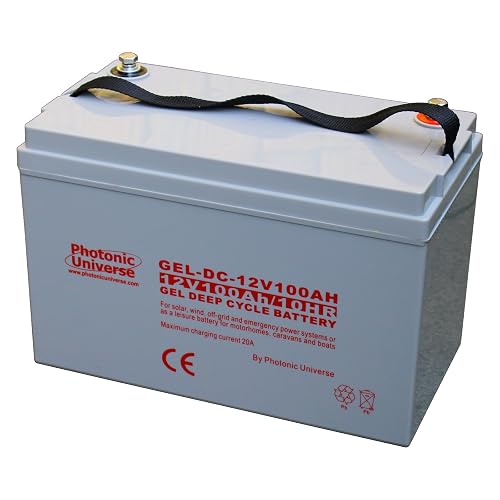
Photonic Universe Gel
A practical leisure battery (gel, 100Ah) for off-grid and leisure power.
Choosing a leisure battery comes down to the chemistry, the capacity, how much of that capacity you can actually use, and how you'll charge it. This guide walks through each so you buy the right battery for how you camp.
Four main types. Flooded lead-acid is cheapest and well proven but heaviest, with the shortest cycle life and needs occasional care. AGM is sealed, maintenance-free, cycles better and mounts in more positions. Gel is sealed and excels at slow deep discharge but prefers gentle charging. Lithium (LiFePO4) is the premium option - most usable capacity, longest life, lightest, fastest charging, but costs the most and needs a lithium-profile charger. Chemistry drives cost, weight, life and usable power.
Capacity is quoted in amp-hours (Ah), but the number that matters is USABLE capacity. With flooded, AGM and gel you should only draw around half the rated Ah before recharging, or you'll shorten the battery's life - so a 100Ah lead-acid gives roughly 50Ah usable. With lithium you can safely use most of the rating, so a 100Ah lithium gives close to 100Ah usable. That's why a lithium battery of the same nominal size roughly doubles your usable power.
Add up your daily power draw - lights, fridge, pump, charging, any inverter - in amp-hours, then size the battery so its usable capacity comfortably covers it between charges, with a margin for cloudy days or longer stops. Under-sizing means running out; massively over-sizing wastes money and weight. Be honest about big loads: a compressor fridge or an inverter running a kettle changes the sums dramatically.
Match the charger to the chemistry: lithium needs a lithium profile (a lead-acid charger can damage it), while flooded, AGM and gel each have optimal settings on a smart charger. Charge from mains, the vehicle alternator (via a suitable split-charge or DC-to-DC system) and solar through an MPPT controller. Recharge lead-acid types promptly and fully. Secure the battery, keep terminals clean, ensure ventilation for flooded types, and never charge lithium below freezing without low-temperature protection.
A practical leisure battery (gel, 100Ah) for off-grid and leisure power.
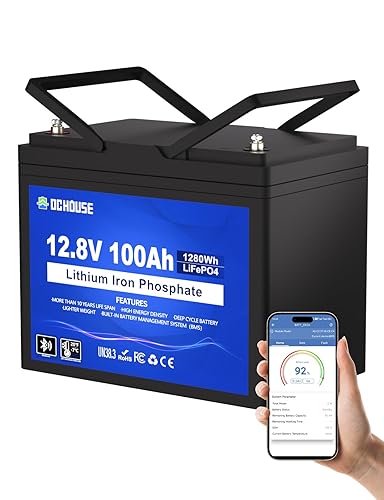
A practical leisure battery (lithium (LiFePO4), 100Ah) for off-grid and leisure power.

A practical leisure battery (deep-cycle, 75Ah) for off-grid and leisure power.

A practical leisure battery (lithium, 30Ah) for off-grid and leisure power.

A practical leisure battery (lithium (LiFePO4), 100Ah) for off-grid and leisure power.

A practical leisure battery (deep-cycle, 100Ah) for off-grid and leisure power.
Start with chemistry (flooded and AGM for value, lithium for the most usable power and longest life), then size the capacity to your real daily draw - remembering you can only safely use about half a lead-acid battery's rating, versus most of a lithium's. Check it fits your battery box and suits your charging setup. Match it to your use: caravan, motorhome, marine or solar. Buy a genuine deep-cycle battery, not a starter battery.
Add up your daily consumption in amp-hours - each device's current draw times the hours you run it - then choose a battery whose usable capacity covers that with a margin. Remember usable capacity is about half the rating for lead-acid and AGM, but most of it for lithium. As a rough guide, modest weekend use suits around 100Ah of lead-acid or less lithium; heavy or off-grid use needs considerably more usable capacity.
Our top pick is the Photonic Universe Gel (our score 9.6/10) - A practical leisure battery (gel, 100Ah) for off-grid and leisure power..