DCHOUSE 12V 100Ah Group 31 Bluetooth LiFePO4 vs DCHOUSE 12V 50Ah LiFePO4
We compare the DCHOUSE 12V 100Ah Group 31 Bluetooth LiFePO4 and the DCHOUSE 12V 50Ah LiFePO4 across every dimension that matters - our scores, the key specs, and how each performs on the things you will actually notice day to day.
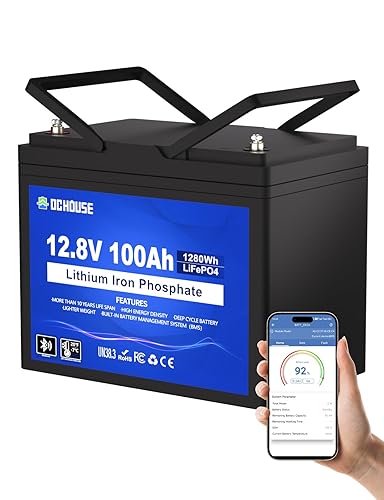

At a glance
| DCHOUSE 12V 100Ah Group 31 Bluetooth LiFePO4 | DCHOUSE 12V 50Ah LiFePO4 | |
|---|---|---|
| Our score | 9.5/10 | 7.4/10 |
| Best for | Maximum usable power, long life and low weight, if the budget allows | Maximum usable power, long life and low weight, if the budget allows |
| Not ideal for | The tightest budgets, or charging from a lead-acid-only charger | The tightest budgets, or charging from a lead-acid-only charger |
| Brand | DCHOUSE | DCHOUSE |
Battery Type and Chemistry
DCHOUSE 12V 100Ah Group 31 Bluetooth LiFePO4
LiFePO4 (lithium iron phosphate) is the chemistry used in the DCHOUSE battery. LiFePO4 is commonly selected for leisure and off-grid systems because it is designed for deep cycling. This battery is also described as having a built-in 100A BMS with low-temp protection, supporting safer operation when temperatures are less ideal. Compared with some other lithium chemistries, LiFePO4 typically involves higher cycle durability, although specific advantages depend on charging setup and use patterns.
DCHOUSE 12V 50Ah LiFePO4
The DCHOUSE battery uses lithium iron phosphate (LiFePO4) chemistry. LiFePO4 is widely used in leisure and mobility power setups because it can support many charge and discharge cycles and is generally regarded as more stable than some other lithium options. In this chemistry, the cell design is intended to help resist rapid breakdown, particularly when compared with more reactive lithium chemistries. A built-in 50A BMS is included to control charging and discharging limits, which reduces stress during use. Correct charging practices and compatible equipment are still required, as performance may suffer if the battery is charged or used improperly.
Capacity and Real Usable Power
DCHOUSE 12V 100Ah Group 31 Bluetooth LiFePO4
A 12V 100Ah rating is the starting point for understanding the energy the DCHOUSE 12V 100Ah Group battery can deliver in real use, but "100Ah" is a capacity figure measured at a defined discharge test and does not guarantee identical usable power under every load and temperature. The leisure battery pack is rated at 12V and 100Ah, giving a nominal energy of about 1.2 kWh (12V x 100Ah). In real-world use, usable energy can be lower if the battery voltage sags under higher current, or if output is limited at low temperatures. Buyers should base expectations on the intended load current, then allow for usable energy to be below the nominal figure.
DCHOUSE 12V 50Ah LiFePO4
With a stated 12V and 50Ah capacity, the DCHOUSE 12V 50Ah LiFePO4 battery is designed to store about 600Wh of electrical energy in ideal conditions. Usable runtime depends on the load profile and discharge depth: higher draw rates and frequent heavy loads reduce the available energy before the battery reaches its end-of-discharge condition. If the system is sized for a steady, moderate current draw, more of the capacity can typically be used, while sudden power spikes can trigger earlier cutoff via the built-in 50A BMS. Runtime therefore varies with device power draw, not just the 50Ah figure.
Cycle Life and Durability
DCHOUSE 12V 100Ah Group 31 Bluetooth LiFePO4
With a stated 5000+ cycle life, the DCHOUSE battery is designed for repeated deep-cycle use, which suits applications such as RVs, off-grid solar setups, and battery-stressed uses including trolling motors. LiFePO4 batteries are typically rated for many discharge-refill cycles.
DCHOUSE 12V 50Ah LiFePO4
Cycle life and durability are a key reason a LiFePO4 leisure battery is chosen over older battery chemistries. The leisure battery unit is specified as offering "4000 - 15000 deep cycles". Cycle life depends on the depth of discharge and the charging routine. A built-in 50A BMS is included to help protect the pack during demanding loads by limiting unsafe behaviour.
Fitting and Charging
DCHOUSE 12V 100Ah Group 31 Bluetooth LiFePO4
Fitting and charging the DCHOUSE 12V 100Ah Group battery typically begins with confirming physical fit, including Group 31 dimensions and terminal layout, for the intended RV or off-grid solar installation. Once the battery is positioned correctly, the installer connects the positive and negative terminals securely and secures the pack to minimise vibration. For charging, compatibility with a suitable 12V LiFePO4 charging approach is required, and the charger settings should be matched to the battery before charging starts. The battery should be monitored during the initial charge phase until voltage behaviour is stable, and charging should not be left unattended until safe operation is confirmed.
DCHOUSE 12V 50Ah LiFePO4
A battery's long service life depends on correct charging and handling, so the "4000-15000 deep cycles" figure only applies when installation and charging are carried out properly. The DCHOUSE should be installed securely with the correct polarity, and kept dry and ventilated (no details are specified on the case). Charging should use the included 5A smart charger, with the battery connected using clean, tight terminals. For best results, charging should be allowed to complete when the charger indicates it is finished, rather than being unplugged early.
Who Is This For?
DCHOUSE 12V 100Ah Group 31 Bluetooth LiFePO4
This battery is aimed at people planning an RV or off-grid solar setup who want a 12V LiFePO4 deep-cycle lithium option suited to frequent cycling, and it may also suit trolling motor use. It is designed to fit a Group 31 size battery space and provide 100Ah capacity for day-to-day energy use where demands vary across the day. The battery includes a 100A BMS with low-temp protection to help prevent unsafe operation if conditions change. Bluetooth monitoring lets users check status without opening the system. Buyers who need specific charging settings should confirm compatibility first.
DCHOUSE 12V 50Ah LiFePO4
The DCHOUSE 12V 50Ah LiFePO4 battery is mainly suited to people who want a lightweight 12V lithium leisure battery for mobility scooter or electric wheelchair use, and for other DC applications mentioned in the product title such as a trolling motor. It fits buyers looking for a 50Ah capacity option in a single 12V battery bundle that can be matched to common 12V set-ups. Choosing it also involves using a lithium battery with a built-in 50A BMS, which is part of the safety system for the battery during operation.
DCHOUSE 12V 100Ah Group 31 Bluetooth LiFePO4: pros
- Lithium (LiFePO4) - most usable capacity and longest life
- 100Ah at 12V
- 5000 cycles rated life
- Suits solar / off-grid
- Built-in BMS, Bluetooth monitoring
Cons
- Higher upfront cost, and needs a lithium-profile charger
- Avoid charging below freezing without low-temp protection
- Match the capacity to your real daily power draw
DCHOUSE 12V 50Ah LiFePO4: pros
- Lithium (LiFePO4) - most usable capacity and longest life
- 50Ah at 12V
- Suits mobility
- Built-in BMS
- Lighter and faster-charging than lead-acid
Cons
- Higher upfront cost, and needs a lithium-profile charger
- Avoid charging below freezing without low-temp protection
- Match the capacity to your real daily power draw
Our verdict
Our pick is the DCHOUSE 12V 100Ah Group 31 Bluetooth LiFePO4 (our score 9.5/10) - A practical leisure battery (lithium (LiFePO4), 100Ah) for off-grid and leisure power. The DCHOUSE 12V 50Ah LiFePO4 is still worth it if it is cheaper when you check, or if it better matches your specific needs.